

If you own a genuine Persian rug, you’ve probably asked yourself this question at least once: how often should you wash a Persian rug without ruining it? Honestly, it’s one of the most common questions we hear from rug owners across Vancouver and North Vancouver, and the answer is more nuanced than most blog posts let on. Wash it too often, and you risk stripping natural lanolin from the wool. Wait too long, and embedded grit quietly grinds away at the foundation like sandpaper.
The good news? Once you understand your rug’s material, weave, and lifestyle exposure, the answer becomes surprisingly clear. This guide breaks down exactly how often you should wash a Persian rug based on rug type, household conditions, and even Vancouver’s famously damp climate, so you can protect an investment that, with proper care, can genuinely outlive you.
The Short Answer (Because You Deserve One)
Let’s be real, nobody wants to scroll through 2,000 words to find the number. So here it is:
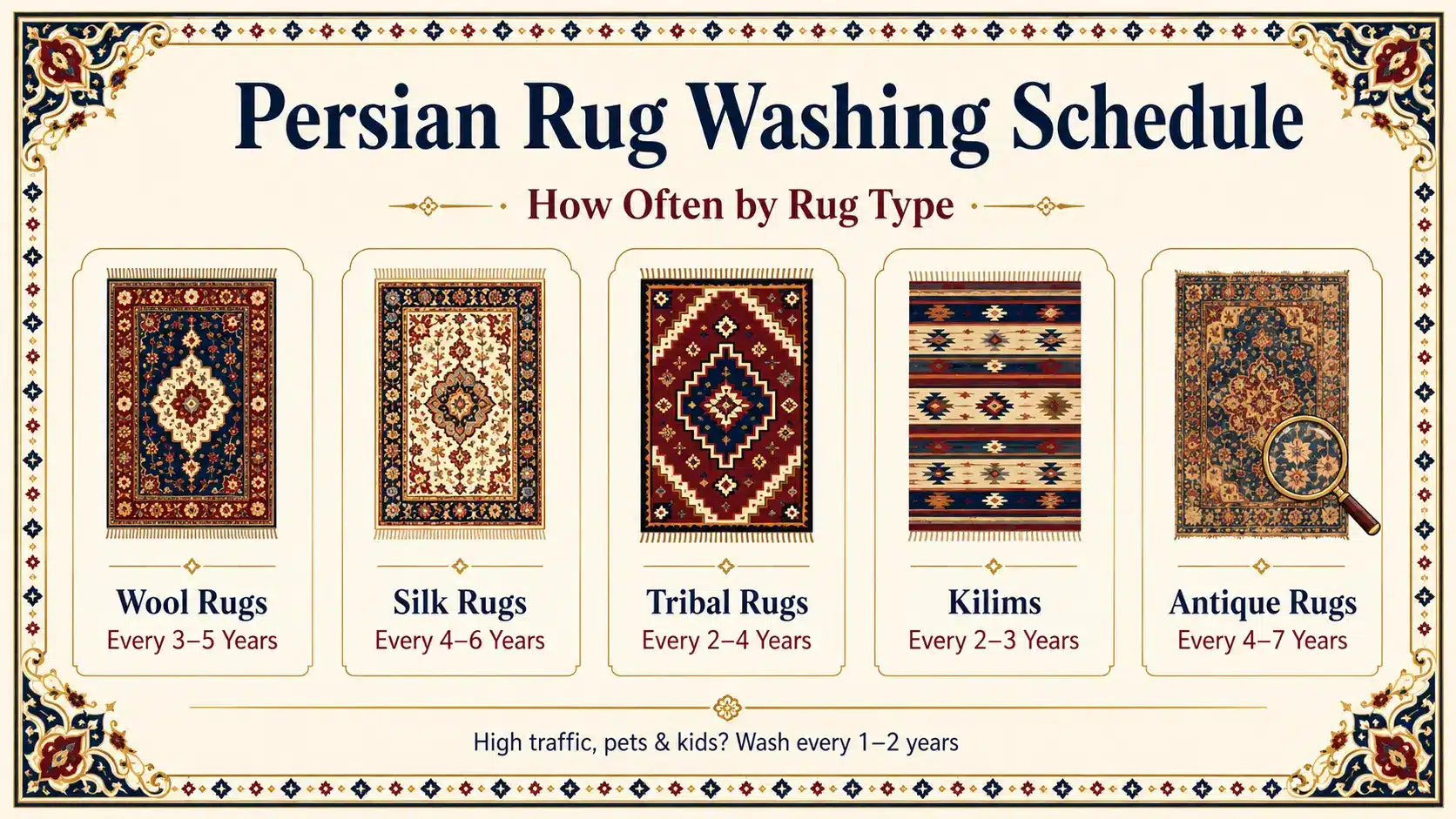
- Most wool Persian rugs: professional washing every 3 to 5 years
- High-traffic wool rugs: every 1 to 3 years
- Silk and silk-blend rugs: every 4 to 6 years, professional only
- Antique rugs (50+ years): every 4 to 7 years, or as condition demands
- Tribal and village rugs: every 2 to 4 years
- Kilims and flatweaves: every 2 to 3 years
Now, before you bookmark this page and leave, those numbers shift dramatically depending on foot traffic, pets, children, and humidity. Keep reading, because the details are where rugs get saved or slowly destroyed.
Why Washing Frequency Actually Matters
Here’s something that surprises a lot of people: a Persian rug rarely dies from being walked on. It dies from being walked on while dirty.
The Hidden Damage of Dry Soil
Every day, microscopic grit settles deep into the pile far below where your vacuum reaches. When you step on the rug, those sharp particles rub against the wool or silk fibres at the base of each knot. Over months and years, this friction cuts through fibres the way sandpaper wears down wood. I once saw a gorgeous Heriz that looked perfectly fine on the surface, but when the owner finally brought it in for cleaning, the foundation was so packed with soil that you could literally shake dust clouds out of it. The pile in the walkway areas had worn down to almost a full centimetre lower than the borders. All preventable.
Overwashing Is Real, Too
On the flip side, washing a hand-knotted rug too frequently or, worse, with harsh detergents, strips the natural lanolin that gives wool its softness, stain resistance, and lustre. It can also stress vegetable-dyed fibres, causing colours to soften prematurely. Balance is everything. That’s exactly why a care schedule by rug type beats any one-size-fits-all rule.
A Persian Rug Care Schedule by Rug Type
Different rugs, different needs. Here’s how the timing breaks down for the rugs we most commonly see in Lower Mainland homes.
Wool Persian Rugs: Tabriz, Kashan, Heriz, Mashad
Wool is wonderfully forgiving. It hides soil, resists staining, and bounces back beautifully after a proper hand wash. For a wool Persian rug in a moderate-traffic room, say, a living room used daily by a couple, plan on a full professional wash every 3 to 5 years.
But ask yourself: is the rug in a hallway? Under the dining table? By the front door? If so, tighten that schedule to every 1 to 3 years. High-traffic wool rugs collect soil at three to four times the rate of a bedroom rug, and no amount of vacuuming fully compensates.
Silk and Silk-Blend Rugs: Qum, Isfahan, Nain
Silk is the diva of the rug world, breathtaking, but demanding. Silk fibres are protein-based and far more delicate than wool, and they should never see a DIY wash, a steam cleaner, or a rental machine. Ever.
Because silk rugs are usually placed in low-traffic display areas (and honestly, they should be), a professional wash every 4 to 6 years is typically sufficient. Between washes, gentle suction-only vacuuming and rotation are your best friends. If a silk rug takes a spill, blot immediately with a dry white cloth and call a specialist; don’t experiment.
Tribal and Village Rugs: Gabbeh, Balouch, Shiraz, Qashqai
These rugs were literally woven to survive nomadic life, so they’re tougher than their refined city cousins. Their chunkier pile, however, tends to trap more debris. A wash every 2 to 4 years keeps them healthy, and their robust wool usually handles cleaning brilliantly, often emerging with colours so refreshed that owners barely recognize them.
Antique and Heirloom Persian Rugs
If your rug is 50 years or older, frequency takes a back seat to condition-based care. Some antiques need washing every 4 to 7 years; others with fragile foundations, dry rot, or previous repairs need a specialist’s assessment before any water touches them.
Really, this is where professional judgment earns its keep. Before washing an antique, it’s wise to have a proper carpet appraisal done so you understand exactly what you own, what it’s worth, and how much handling it can safely tolerate. An heirloom Kerman passed down from your grandmother deserves more caution than a rug bought last year.
A Quick Word on Kilims and Flatweaves
No pile means soil sits closer to the surface, making it easier to vacuum but also quicker to show grime. Flatweaves generally benefit from washing every 2 to 3 years, and because both sides are exposed, flipping them seasonally doubles their visual lifespan.
Factors That Change Your Washing Schedule
The rug-type schedule above is your baseline. These real-life variables move the needle sometimes a lot.
Foot Traffic: The Biggest Variable
A rug in a formal sitting room used twice a month might comfortably go five or six years between washes. That same rug in an entryway? It could need attention annually. A simple test: fold back a corner and firmly pat the back of the rug over a white sheet. If a little cloud of fine grey dust appears, your rug is due regardless of what the calendar says.
Pets and Young Children
We love them, but let’s be honest, they’re rough on rugs. Pet dander, tracked-in mud, dribbled juice, and the occasional accident all accelerate the schedule. Households with dogs, cats, or kids under ten should generally wash wool rugs every 1 to 2 years. Pet urine, in particular, is urgent: it’s acidic going in, turns alkaline as it dries, and can permanently alter dyes and even rot cotton foundations if it sits.
Vancouver’s Climate Is a Factor Seriously
Living in Vancouver or North Vancouver adds a unique wrinkle: moisture. Our long rainy season means damp shoes, humid air, and a real risk of mildew in rugs placed near entrances or on concrete floors. Wet-climate homes often benefit from slightly more frequent washing, plus a quality rug pad that allows airflow underneath. If you ever detect a musty odour rising from a rug, don’t wait for your scheduled wash; that’s mildew announcing itself, and it spreads.
Anyone shopping for Persian rugs for North Vancouver homes should also factor placement into the purchase itself: a moisture-tolerant, densely knotted wool piece near the door, and the delicate silk showpiece safely in the living room.
Between Washes: The Habits That Buy You Years
Professional washing is the deep reset, but what you do weekly matters just as much. Think of it like dental care: the cleaning appointment helps, but daily brushing does the heavy lifting.
Weekly: Vacuum with suction only (no beater bar) in the direction of the pile. Twice weekly in high-traffic zones.
Monthly: Vacuum the underside of the rug and the floor beneath it. You’ll be shocked at what accumulates under there.
Every 6–12 months: Rotate the rug 180 degrees to even out wear and sun exposure. Vancouver’s south-facing windows can fade one side of a rug noticeably within a few years.
Immediately, always: Blot spills with a clean white cloth never rub, never use grocery-store carpet sprays, which can set stains and bleach vegetable dyes.
Small story: a client once rotated her Kashan religiously every six months for fifteen years. When she finally brought it in for washing, the wear pattern was so even that the rug looked a decade younger than identical pieces from the same era. Rotation is free. Do it.
Professional Washing vs. DIY: Where’s the Line?
Can you wash a Persian rug yourself? Technically, some people do. Should you? For a genuine hand-knotted piece, no.
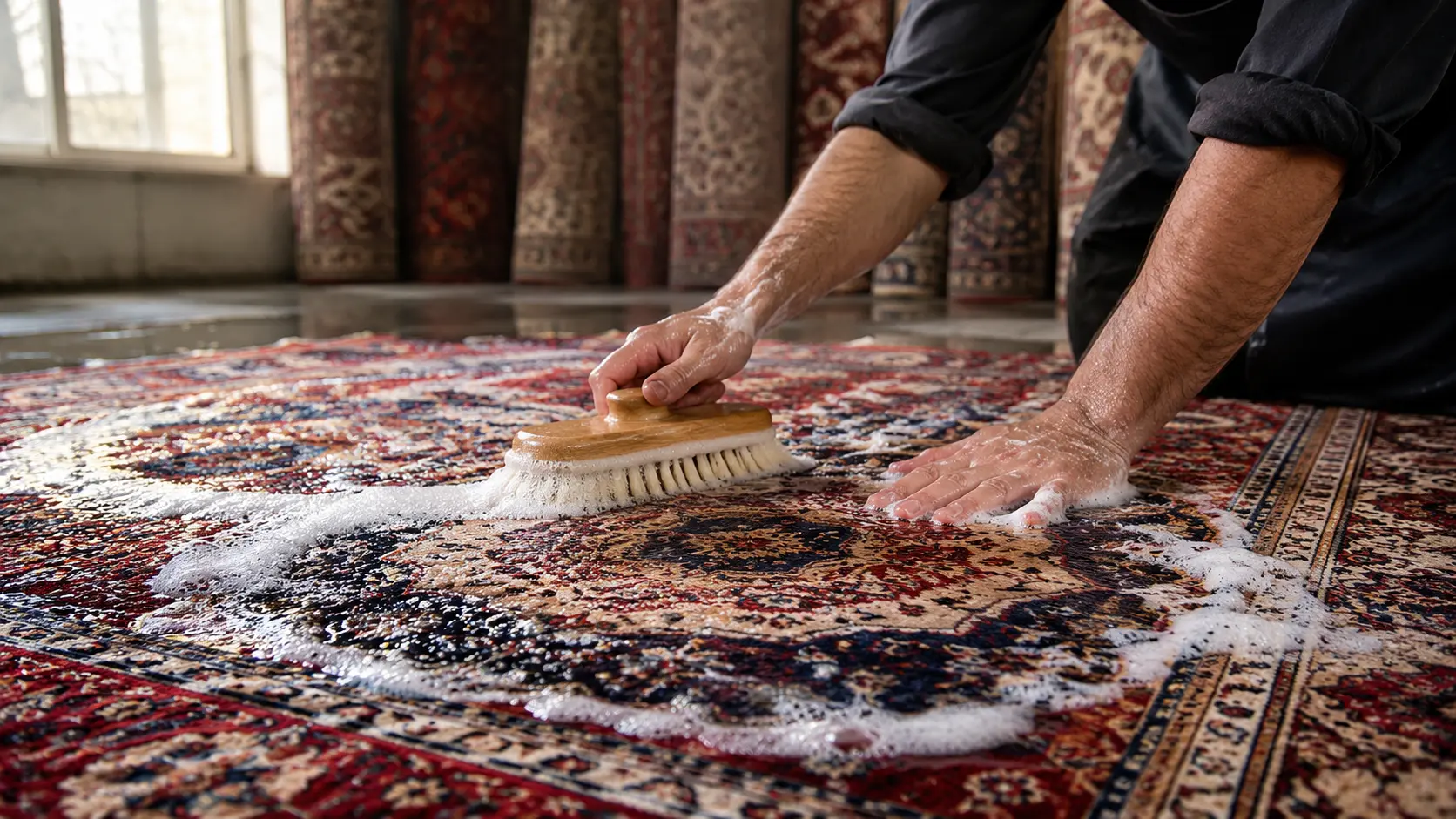
Proper Persian rug washing involves dusting the foundation, pH-balanced shampoos matched to the dye type, controlled water temperature, dye-bleed testing, and flat drying with air circulation. Get any step wrong, and you can end up with colour migration, shrinkage, wavy edges, or mildew inside the foundation. Machine-made synthetic rugs? Sure, experiment away. But hand-knotted wool and silk deserve hands that have washed thousands of them.
Anyone who has invested in an authentic Iranian carpet, which Vancouver collectors would envy, knows the piece is both furniture and an asset. You wouldn’t service a vintage Rolex with a kitchen screwdriver.
When to Call a Professional Immediately
Skip the schedule entirely and get help right away if you notice: pet urine odour, visible mildew or musty smell, moth activity (look for sandy debris and bare patches on the back), flooding or major water exposure, or colour bleeding after a spill. These problems compound weekly.
Washing, Condition, and Your Rug’s Value
Here’s an angle many owners overlook: maintenance history directly affects value. A well-documented, professionally maintained rug commands noticeably more in resale, insurance, and estate contexts than an identical piece with packed-in soil and untreated stains.
If you’ve inherited a rug or haven’t had yours evaluated in years, pairing a professional wash with a Rug Appraisal in North Vancouver service is a smart double play: the wash reveals the rug’s true colours and condition, and the appraisal documents its value while it looks its best. For insurance purposes especially, an up-to-date valuation of quality Persian carpets in Vancouver homeowners keep in daily use is something you’ll be very glad to have before you ever need it.
Conclusion
So, how often should you wash a Persian rug? For most wool pieces, every three to five years; for silk, every four to six; for busy households with pets and kids, tighten everything to one to two years; and for antiques, let condition and a professional’s eye set the pace. Between washes, consistent vacuuming, prompt spill response, and twice-yearly rotation will do more for your rug’s lifespan than almost anything else. A genuine Persian rug is one of the few things in your home designed to last a century, but only if the grit, moisture, and stains of daily life are cleared out before they cause structural harm. Treat the schedule in this guide as your baseline, adjust for your household, and your rug will reward you with decades of colour, character, and quiet luxury underfoot.
Ready to give your rug the care it deserves?
Whether you need expert hand washing, restoration, or a certified appraisal, the team at Shenasi Carpet has been trusted by rug owners across Vancouver and North Vancouver for decades. Visit us online at shenasicarpet.com to learn more or book a service, or search “Shenasi Carpet” on Google Maps to find our showroom, browse customer reviews, and drop by in person. Your Persian rug has a long life ahead of it. Let’s make sure it gets there.